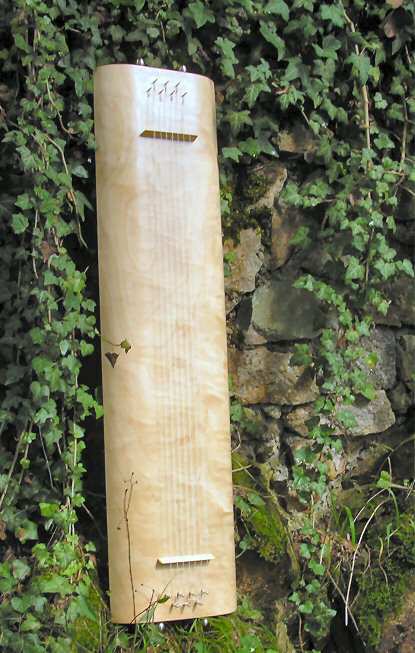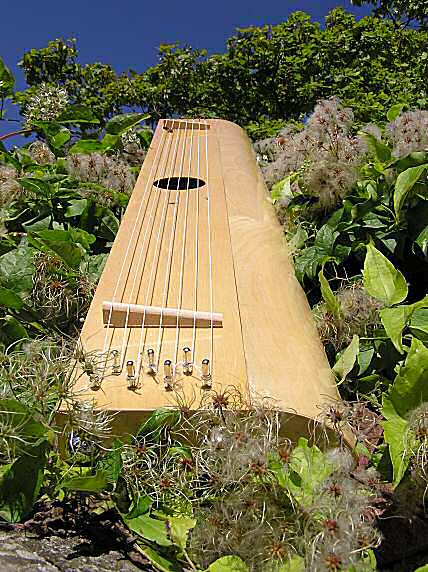
...meine derzeitige Quintessenz der Äolsharfe...
Viele Versuche wurden gemacht um optimale
Instrumentendimensionen und damit
Klang-Qualität zu
erzielen.
Die Dauerhaftigkeit und Klangeigenschaften von
Materialien für
Korpus, Saiten, Lacken und Veredelung der Metallteile wurden getestet
sowie - nicht zu vernachlässigen - die Transportmöglichkeit.
Warum dieses Design?
Bei den
althergebrachten Windharfentypen ist normalerweise die Saitenebene
fast völlig verdeckt durch einen mehr oder weniger sperrigen
"Windtrichter", der den Wind
bündeln (die Wirkung ist besser umschrieben mit
Wirbelunterdrückung) und ihn auf die Saiten aufleiten
soll.
Durch diesen Trichter geht leider der Harfen-/
Zither-Charakter des Instruments vom Aspekt her verloren.
Vom
Drachenflug bzw. Flugzeugbau abgeleitet ergaben Experimente, daß
die aufwendigere Konstruktion
eines "Vorflügels" den Wind besser "bündeln"
und auf die Saiten leiten kann als dies ein "Wind-Trichter"
kann.
Durch diesen "Wind-Flügel"
bleibt im Gegensatz zum "Wind-Trichter" der optische
Eindruck einer Harfe oder Windzither erhalten.
Die
Saiten sind immer sichbar und können sogar während des
Spielens berührt werden.
Die Saiten sind zum Stimmen frei zugänglich.
Eine entscheidene Verbesserung
gegenüber dem alten Windtrichter ist, daß der
Arbeitsbereich des Instruments in klangoptimierender Weise vergrößert
wird.
Dadurch hat dieser Windharfentyp eine viel bessere Chance auch dann noch Töne zu erzeugen, wenn der Wind bei waagerecht aufgehängter Windharfe senkrecht zur Saitenebene Richtungsabweichungen aufweist (also schwankende Windrichtung zum Erdboden hin/ vom Erdboden weg; in Bezug auf die Saitenebene bedeutet dies einen möglichen Anströmwinkel von ca. -35° bis +55° bei dem die Harfe tönt!)
Durch eine waagerechte
Aufhängungsmöglichkeit parallel
zum Erdboden wird zusätzlich der mögliche
Anströmwinkel parallel zur Saitenebene auf bis zu 120°
aufgeweitet, was Funktionssicherheit
gibt, wenn der Wind von der Hauptwindrichtung (auf den
die Harfe ausgerichtet ist) abweicht und "strahlt".
Dagegen
verstummen die althergebrachten Windharfen (die meist lotrecht
eingebaut wurden) bereits bei geringem Windrichtungswechsel...
Ein weiterer Aspekt ist, daß durch Herausdrehen der Aeolsharfe aus dem Wind die Windstärke künstlich vermindert werden kann, wenn es einmal allzu stark bläst...
|
|
|
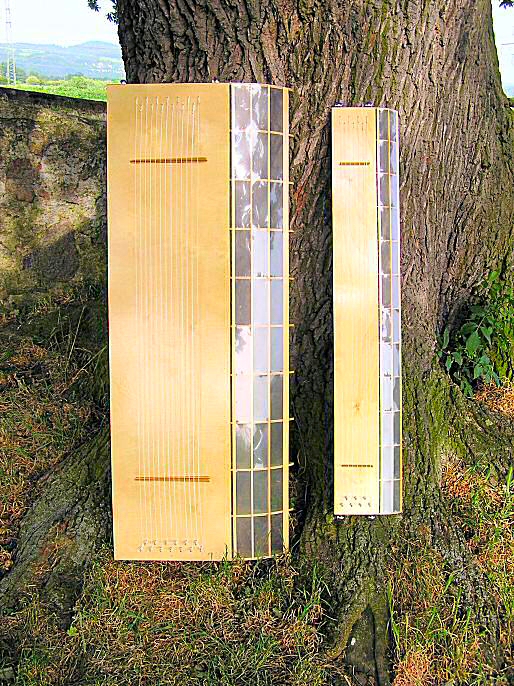
Kleine und große Windharfe. |
Technische Daten der hier vorgestellten Äolsharfen:
|
Material |
: |
Birken-Flugzeugsperrholz |
im Gegensatz zu Vollholz auch bei feuchter Witterung kaum Gefahr von Rißbildung im Holz. Warum überhaupt Holz? Es klingt einfach besser... |
|
Lack. |
: |
wetterfeste Lackierung |
wetterfest/ UV-beständig,
bleibt lange elastisch. |
|
Saiten |
: |
feuchteunempfindliche |
im Gegensatz zu früher verwendeten Gitarren-Metallsaiten oder Darmsaiten wetterfest und beständig gegen UV-Licht |
|
Stimmwirbel |
: |
Automatenstahl mit Vierkantkonus, glanzvernickelt |
Zitherwirbel mit feinem
Linksgewinde |
|
Saiten-Einhängestifte |
: |
Stahl, glanzvernickelt |
Wenn es jemanden gibt, der mir die Wirbel in Edelstahl herstellen könnte, wäre das natürlich SUPER.... |
|
Aufstellfüße. |
: |
Messing natur |
die Kugelfüße sind abschraubbar um bei Bedarf die Windharfe anders aufhängen zu können |
|
Kleine
Harfe |
: |
Länge.....125
cm |
Maße einschließlich Vorflügel/ Windflügel. |
|
Freie Saitenlänge ca. |
: |
94 cm |
|
|
Gewicht ca. |
: |
2,5 kg |
|
|
GROSSE
HARFE |
: |
Länge.....140
cm |
Maße einschließlich Vorflügel/ Windflügel. |
|
Freie Saitenlänge ca.. |
: |
110 cm |
|
|
Gewicht ca. |
: |
10 kg |
|
|
Zubehör |
: |
1 Ersatzwirbel, 1
Einhängestift, |
|
|
|
: |
|
|
Die „Doppelharfe“...
...klingt in Heilbronn in einem privaten Garten...
|
|
|
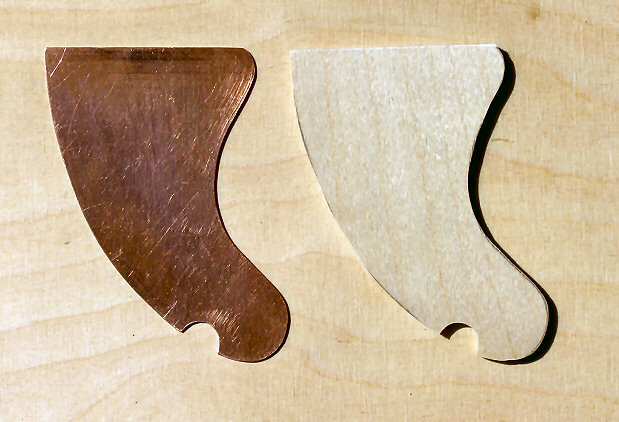
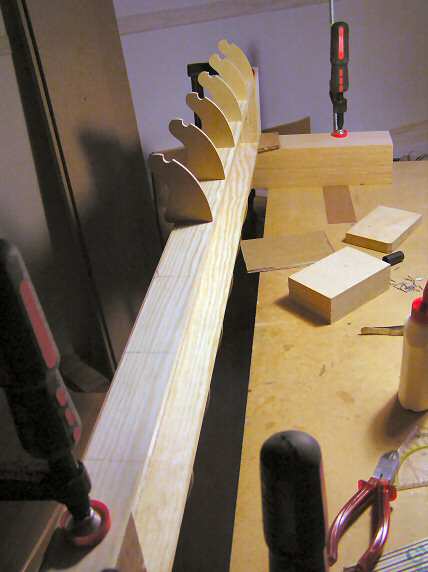
Am Anfang der Windharfe stehen die Flügelrippen... |
|
|
|
...sie müssen alle exakt gleich sein... |
|
|
|
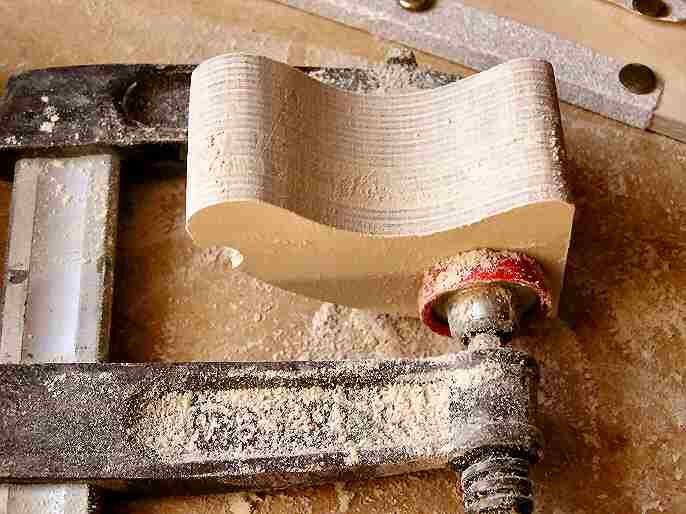
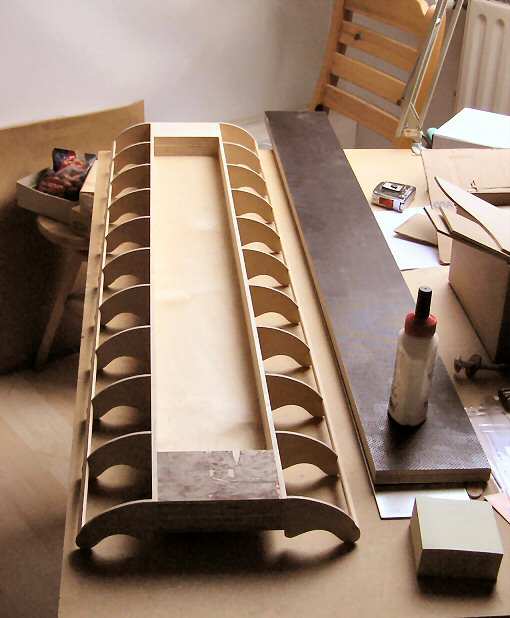
...damit sie später genau passen... |
|
|
|
...wenn sie auf den Klangkörper aufgeleimt werden. |
|
|
|
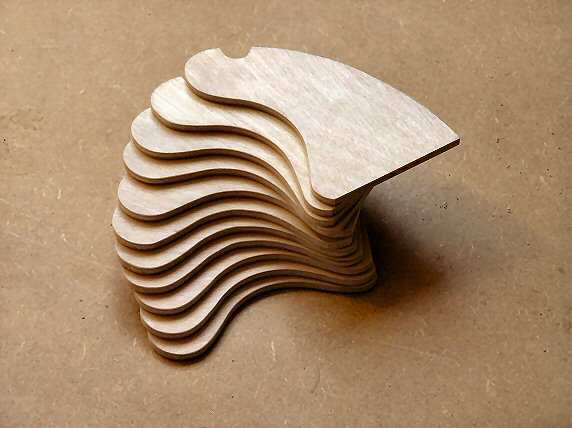
Der Aufbau
der Windharfe und ihrer Flügel ist analog einem
Flügzeugflügel, |
|
|
|
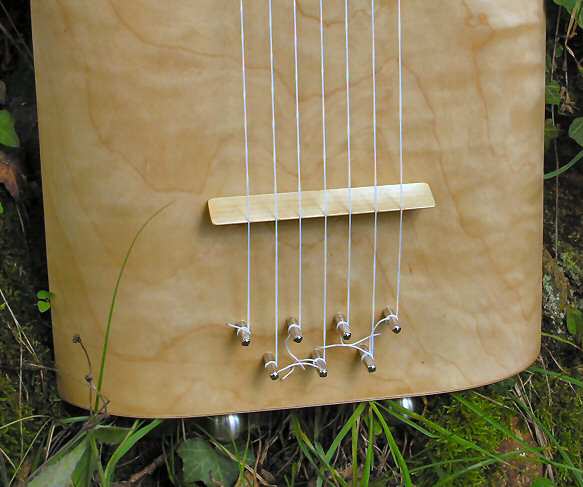
...auf die mit Wirbeln gestimmten... |
|
|
|
...und von Stiften gehaltenen Saiten zu gleiten um... |
|
|
|
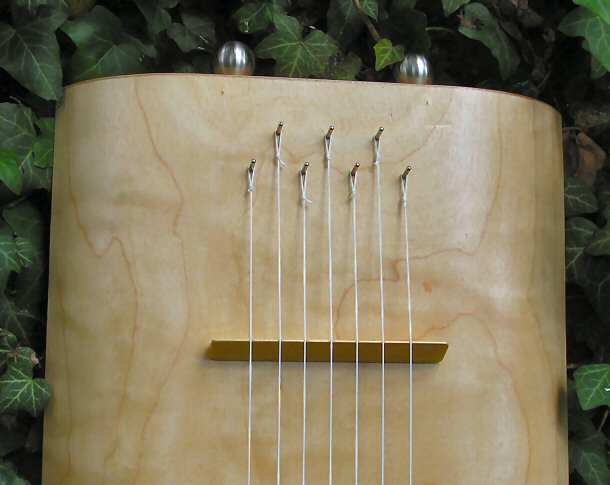
...die Melodien der Äolsharfe erklingen zu lassen... |
Zum Schluß möchte ich neben der Hauptseite über Windharfen noch eine "Anleitung" erwähnen, die anno 1799 geschrieben wurde und bis heute nichts von ihrer Gültigkeit verloren hat...
Ideen, Kritik,
Ergänzungen, Fragen...?
Developed
and constantly completed by
Uli Wahl, All
Rights Reserved
Zurück zu Kite Musical
Instruments/ Aeolsinstrumente Hauptseite
.
.
.
.
.
.
.
.
.
English version following below...
.
.
.
.
.
.
.
.
.
...my personal "state of the art" of the Wind-Harp...
On demand this Aeolian Harp will be built for you
following the description below.
Many trials were made in order to find optimal
instrument's dimensions, achieving real sound
quality thereby.
Tested were durability and
sound-properties of the materials used for
instrument's body, strings, lacquers and metal parts' coatings and -
last but not least - the possibility of transporting...
The reason why this design was developed?
When looking
at the traditional types of aeolian harps, the string's plane is
normally completely covered by a more or less bulky "wind-funnel",
directing the wind onto the strings.
By this funnel,
the instrument's aspect of a harp or a zither gets almost
lost.
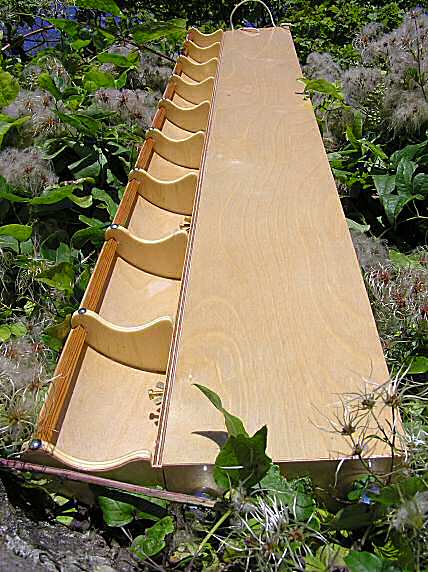
Derived by aeroplane building,
experiments demonstrated
the advantage of a slat or a little "wing", leading the
airflow much better onto the strings than a funnel could do.
With
this detachable "winglet" the optical aspect of a harp or
zither is maintained completely
The
strings are always visible and even can be touched while playing.
For tuning, the strings are free accessible.
An important improvement in comparison
with the "wind-funnel" from old is the instrument's
enlarged working space in a sound-optimizing manner.
Thereby this type of aeolian harp has a much
better chance in producing sounds even when the wind blows in
varying vertical directions (harp hanging horizontal) in relation to
the ground-plane.
In
relation to the string's plane this means a possible
wind-direction/-angle of ca. -35° to +55° with sound fully
functioning!
In addition, by the
harp hanging horizontal/ parallel to the ground, the wind's possible
angle of attack parallel to the string's plane is increased up to
120° giving functional safety when the wind is changing the
points of the compass.
In
contrary the windharps from old fall silent under these
conditions...
A further aspect is, that the windspeed in relation to the strings can be diminished by simply turning the harp's strings out of the wind. Wind hitting the strings perpendicular = maximum speed (loud/ high sound); wind almost parallel to the strings = almost zero windspeed (low sound)...
|
|
|
Small and big Aeolian harp. |
Ratings of the Aeolian Harp presented:
|
Material |
: |
Birch plywood (aeroplane quality) |
in contrary to solid/ full
wood even under humid conditions |
|
Varnish |
: |
Weatherproof Varnish |
weatherproof/ UV-proof, keeps elastic for a long time |
|
Strings (7 pc.) |
: |
Synthetic fibre
strings |
in contrary to the gut strings used in former times or metal guitar strings, the material is UV-proof |
|
Tuning pegs |
: |
Steel with square conical head, nickel bright plaited |
Zither-tuning pegs with
lefthand thread |
|
String's |
: |
Steel, nickel plated (bright) |
|
|
Assembly bowl-feet |
: |
Brass, chromium plated (bright) |
the bowl feet can be detached for the possibility of changing the way of suspension if necessary |
|
Measure Corpus |
: |
Length.....125
cm |
Measures including the "wing" |
|
Free length of the strings |
: |
94 cm |
|
|
Weight ca. |
: |
2500 g |
|
|
Accessories |
: |
1 spare tuning peg, 1
spare string fastening peg |
|
|
|
: |
|
|
Ideas, Criticism,
Questions...?
Developed and
constantly completed by
Uli Wahl, All Rights
Reserved
Go back to the page you came from by pressing the "Back" button of your browser...
or
Back to Kite Musical Instruments/ Aeolsinstruments Index Page